How DAKA uses customer research and data to refine its omnichannel strategy

Sports retail chain DAKA is fully committed to combining in-store and online shopping. Using customer research and smart data utilisation, the retailer links specialist knowledge from its shops to its digital channels. "It makes DAKA unique: the combination of shop, online and event experience," says Richard Schenderling, e-commerce manager at DAKA.
DAKA is a Dutch family business with around 17 shops and an extensive online store. Fifteen years ago, the retailer was still mainly a regional player with five shops in South Holland. Now, the sports shop chain operates nationwide. Richard Schenderling, e-commerce manager at DAKA, explains: "On our 50th anniversary, ten years ago, we acquired another sports retailer. This suddenly gave us national coverage and we grew to 13 shops." Further expansion with new shops remains important for DAKA. "The challenge is to find suitable locations: premises of 3.000 to 5.000 square metres in city centres."
Specialism on the shop floor
The strength of the shops lies in their specialism on the shop floor. "We distinguish ourselves through the presence of genuine professionals. We extend this core value into our digital strategy. We see many opportunities in the combination of website and shop."
The company is assisted in this by XSARUS, with whom it has been working for 15 years. "We mainly support DAKA in further developing its digital strategy," says Alexander Robijn, sales & marketing manager at XSARUS. Schenderling adds: "We have lots of ideas, but we want to validate them with data. XSARUS has expertise in CRO, data, and a full-service approach. The added value lies mainly in bundling specialist knowledge from the shops and making it visible online. This ensures that our reputation as an offline specialist is also fully recognisable online."
Omnichannel approach
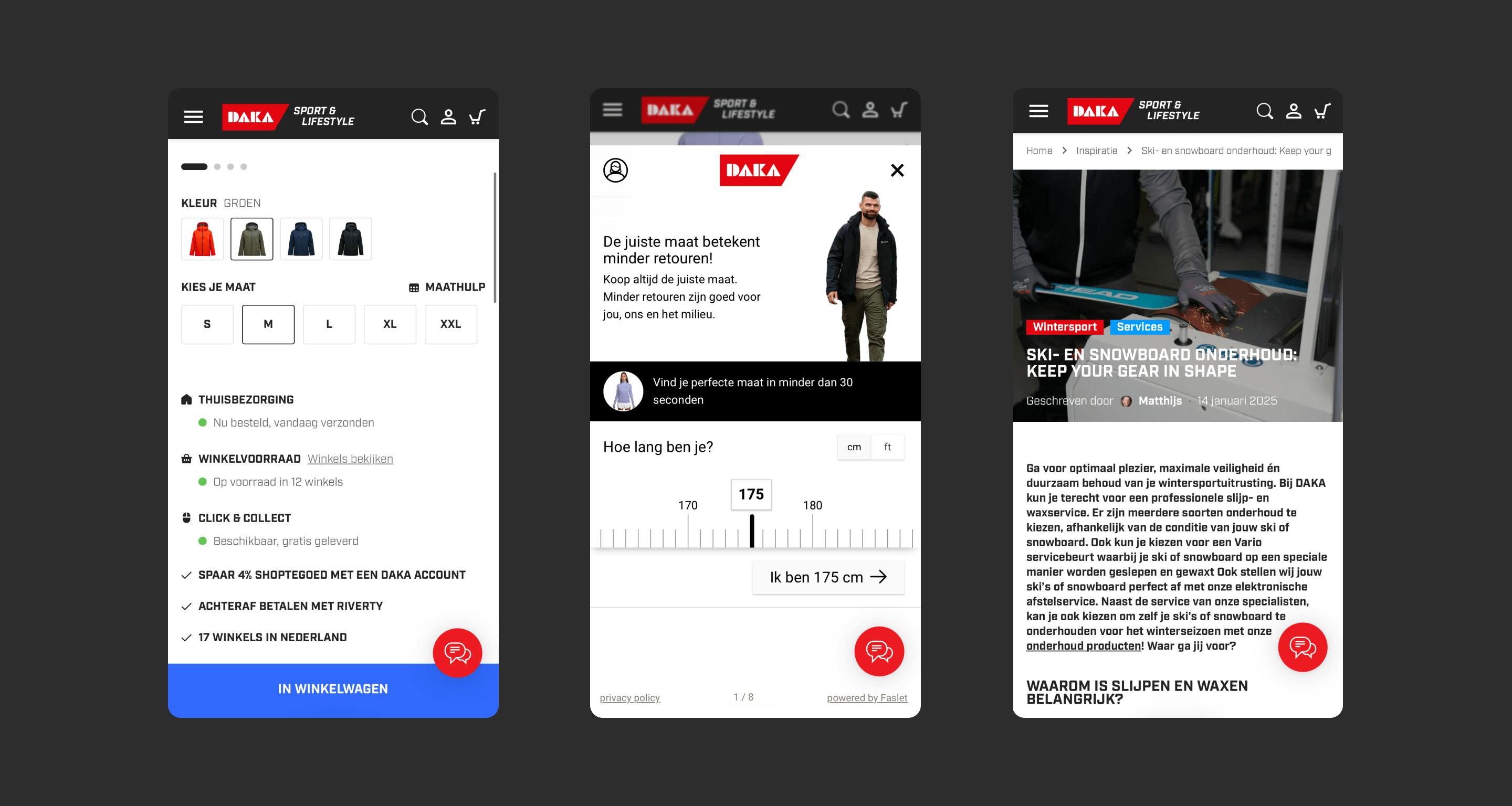
This is now being done in various ways. Schenderling: "On the one hand, we offer online offline information such as click & collect and store stock. On the other hand, we provide inspiration: shopping pages with good photography that convey the feel of the stores. We blog more: information that we share in the stores is also posted online via inspiration pages. We use our specialists on the shop floor for this."
Another concrete application is size advice. "Two years ago, we added size advice: weight, height, body type, to provide advice based on supplier tables. This increased conversion and reduced returns. However, differences in sizing between brands remain a challenge. That's why customers often choose click & collect, so they can be sure that the product is available and they can try it on."
To test the effect of this approach and further improve the online experience, DAKA recently conducted a customer survey in collaboration with XSARUS. "We looked at how customers behaved, who visited which pages online, and what exactly those customers' needs were. How can we respond to that?" explains Robijn. "This revealed, among other things, that the purchase button is less important than viewing the store's inventory on the ski boot pages. Prominently displaying DAKA's various services also appears to work well."
Trying on clothes in the shop
The omnichannel approach is most visible in the largest sports category: winter sports. "In this segment, a lot of orientation takes place online," explains Schenderling. "Some products are ideal for customers to buy online, but we prefer to sell certain categories, such as ski boots or snowboard boots, in-store." This is where we can offer much more expertise and service. "In the shop, for example, we have a 3D foot scan. We actually believe that everyone should have this scan done before buying ski boots, so that they get the perfect fit."
The challenge, therefore, is to attract online customers to the shop. "We do this in various ways." Schenderling gives an example of how this works: "The ski boots pages will soon feature a 3D foot scan, along with tips from blog posts. For example, we recommend that when you come to try on boots, you don't wear skinny jeans or trainers socks, but loose-fitting trousers and ski socks."
New online shop
To further improve the omnichannel approach, a new webshop has been built. "It is faster, more stable and more scalable. We have a new CMS and a new search & merchandise tool. This allows us to develop faster and take on more ourselves. Fixed templates have been integrated to maintain the corporate identity, but there is also flexibility to add things ourselves."
This flexibility makes it possible to respond quickly to customer behaviour. "If, for example, we want to add extra information between the size selection and the purchase button, this can be arranged within an hour. That works well, especially for the content department."
The next step is artificial intelligence. "Our AI chatbot will go live soon. Initially for order status and FAQs, but later also for product advice as a digital assistant."


Events and experiences
Experience is also a recurring theme in DAKA's strategy. Every year, the chain organises its winter opening on a glacier in Sölden, Austria, where the latest collections are showcased. The end-of-season event during Dutch Week in Val Thorens also attracts many visitors. In between, a special DAKA bus travels to various locations, filled with new collections, test products and a Daka.nl kiosk.
“We always translate these events to online, with event pages, registration forms and communication to customers,” says Schenderling. “It makes DAKA unique: the combination of shop, online and event experience.”
Opportunities for growth
Looking ahead, DAKA sees plenty of growth opportunities, both in the Netherlands and abroad. Schenderling: "We want to grow in provinces where we are less well known. From Venlo, we see that German customers are also finding their way to us. That is why we are working on multilingualism and international growth. In five years' time, we expect to be active in several countries."
The online ambition is also clear: "Our goal is for online sales to represent 20 to 25 percent of total turnover. That is currently about half of that. We are working towards this by further developing decision aids, blogs and chatbots." Robijn concludes: "If we succeed in fully translating the specialist knowledge of the shops to online, consumers will experience the same expertise and service everywhere. Regardless of the channel. That is the dot on the horizon."
This article was recently published on the RetailTrends website.
